

For twenty years, the enterprise software playbook has been remarkably stable: buy a platform, configure it, standardize your processes around it, and scale through seats. SaaS won because it removed friction. It let companies move fast without building anything themselves.
That playbook is now working against you.
The current wave of enterprise AI is being sold through the same model — a Copilot here, an "Einstein" feature there, a new per-seat tier that promises productivity gains without the burden of building. And for lightweight use cases like drafting, summarizing, and searching, these add-ons deliver real value.
But most enterprises aren't struggling with drafting emails faster. They're struggling with workflow automation, operational decisioning, domain-specific reasoning, and system integration at scale. Those problems demand something SaaS add-ons were never designed to solve.
If AI is going to meaningfully reshape how your business operates, it cannot live as a feature layer on top of generic workflows. It has to be designed into your systems, your data, your rules, and your operating model. That means building — and for a growing number of enterprises, it means owning the capability rather than renting it.
The Structural Limits of SaaS AI
SaaS add-ons are built for broad adoption. That's their strength, and it's also their ceiling.
To serve thousands of companies with different data architectures, governance requirements, and legacy constraints, vendors have to standardize aggressively: what data can be used, which workflows are supported, what integrations exist, and how much customization is permitted. The result is a product optimized for the median customer — not for yours.
This is fine when the goal is individual productivity. It becomes a problem when the goal is competitive advantage. A capability that every competitor can activate by toggling the same vendor setting isn't a differentiator. It's table stakes.
The question enterprise leaders should be asking isn't "Should we adopt AI?" — it's "Are we building an asset, or subscribing to a commodity?"
Where Custom AI Systems Create Separation
The case for building isn't ideological. It's structural. Custom AI systems address five specific limitations that SaaS add-ons struggle to overcome.
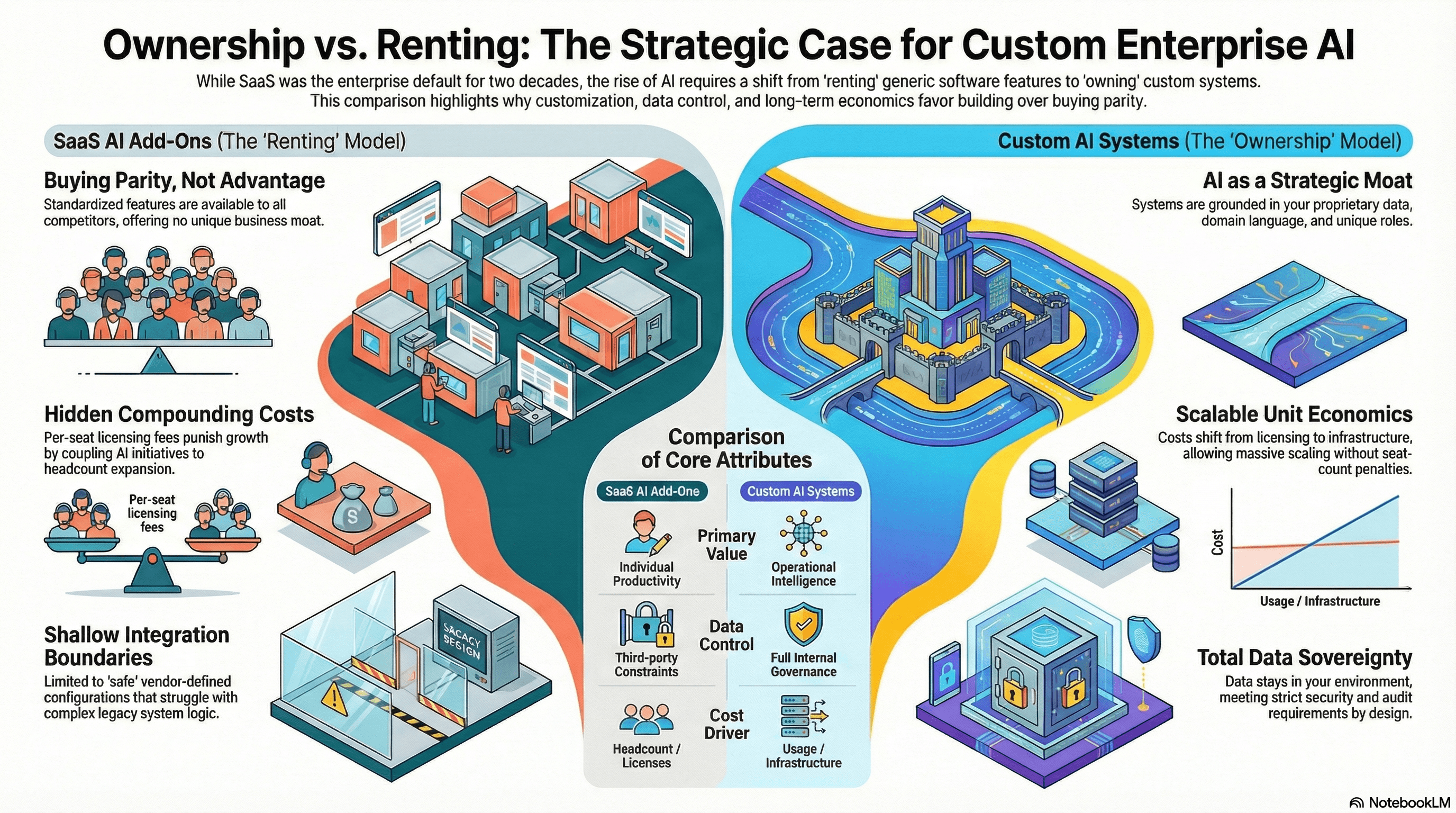
Cost dynamics that reward growth instead of punishing it
SaaS AI pricing is typically per-seat and per-tier, which means your AI investment scales linearly with headcount. As adoption grows across departments, you pay the vendor more every year simply for doing what you intended: getting people to use it.
Custom systems invert that relationship. The upfront investment is real, but long-term costs become tied to infrastructure and throughput — not seat counts. You can extend AI capabilities to thousands of employees without your unit economics deteriorating with every new user.
Depth that generic platforms can't replicate
The most valuable AI use cases in any enterprise sit in the specific: your proprietary data, your decision rules, your domain language, your exception-handling logic, your risk models. These are the areas where automation and intelligence create genuine operational leverage — faster cycle times, fewer errors, sharper forecasting, smarter exceptions handling.
SaaS add-ons don't have access to this depth, and they aren't designed to. Custom systems are built on top of it. That's the difference between AI as a feature and AI as a moat.
Data control that meets real governance standards
Enterprises in regulated industries — financial services, healthcare, defense, critical infrastructure — face strict requirements around data residency, privacy, and auditability. SaaS add-ons process your data inside the vendor's architecture, often in ways that are difficult to fully validate against your own compliance standards.
Custom systems keep the control plane where it belongs: inside your environment, governed by your security model, auditable to your requirements, and calibrated to your risk tolerance rather than the vendor's. For many enterprises, this isn't a preference. It's a prerequisite.
Integration that reaches the actual systems of record
One of the most common failure modes with SaaS AI is shallow integration — surface-level connectors, constrained APIs, and generic workflows that don't reflect how your legacy systems actually behave.
Enterprise operations run on a web of ERPs, CRMs, homegrown platforms, data warehouses, and internal APIs that encode years of accumulated business logic. AI that can't reach deeply into these systems is limited to augmenting individual tasks. AI that can orchestrate across them — triggering actions, handling exceptions, operating with production-grade reliability — becomes part of the operational fabric. That's the shift from "assistant" to "system."
Economics that compound in your favor
SaaS costs compound against you: more users, more spend, more dependency. Custom systems compound for you. Once the foundation is operational, you gain options that subscription models don't offer: expand capabilities without renegotiating licenses, swap underlying models without replatforming, reuse components across business units, and build new workflows faster because the architecture already exists.
You stop paying perpetually for access and start investing in an asset your enterprise owns.
Why This Is Hard — and Why That's the Point
If the case for custom AI is so clear, why isn't everyone building?
Because building well inside an enterprise is genuinely difficult. It requires balancing security and governance with speed of delivery. It demands stakeholder alignment across business and technology leadership. It means working within legacy constraints, meeting production reliability standards, and managing organizational change — all simultaneously.
Prototyping is easy. Shipping AI that works in production, that can be supported and scaled and trusted by the business, is a different discipline entirely.
But that difficulty is precisely what makes custom AI defensible. The enterprises that develop the ability to build, deploy, and operate their own AI systems — not just procure them — will hold an advantage that compounds over time. The ones that default to the vendor path will find themselves paying more for capabilities that look increasingly similar to what every competitor has.
The Strategic Frame
SaaS AI add-ons are not the enemy. They have a role, particularly for horizontal productivity use cases where speed of adoption matters more than depth.
But the most consequential AI use cases in any enterprise — the ones that touch operations, decisioning, risk, and domain expertise — will not be solved by a vendor who serves ten thousand other companies with the same product. Those use cases require systems designed around how your business actually works, built on your data, and governed by your standards.
The enterprises that recognize this distinction early will build the capability to own their most valuable AI systems. The rest will rent what everyone else is renting — and wonder why it never becomes the advantage they were promised.