TribalScale | Building an Enterprise Agentic Platform for Delivery, Operations, and Personal Productivity
Case study creation reduced from days to approximately 15 minutes through automated content generation workflows.
20 active employees adopted Personal Agents, streamlining timesheets, scheduling, HR support, and productivity workflows.
Enterprise-scale agent operations run for approximately $20–40 USD per day, supporting scheduled and reactive workflows across the organization.

Transforming fragmented automations into a governed multi-agent platform that accelerates delivery, streamlines operations, and empowers employees through AI.
Challenge
TribalScale's internal systems had evolved organically over time, creating operational inefficiencies that limited scalability.
Key challenges included:
Disconnected automations with no shared runtime, memory model, or governance framework.
Knowledge fragmented across Slack, Google Drive, GitHub, JIRA, and operational systems.
Strict privacy and security requirements that made unrestricted AI tool access unacceptable.
Limited visibility into agent capabilities, behaviour, and data access.
A serverless operating model that required agents to function through event-driven invocations rather than continuously running services.
The goal was not simply to deploy AI assistants, but to establish a scalable enterprise architecture that could support delivery operations, people & culture programs, proposal generation, and employee productivity from a single platform.
Solution
Like many growing organizations, TribalScale had accumulated a collection of disconnected automations, Slack bots, scheduled scripts, and manual workflows. Valuable knowledge was scattered across Slack conversations, Google Drive documents, Git repositories, JIRA tickets, and operational systems, making it difficult for employees to access the right information or automate work consistently. Rather than deploying isolated AI assistants, TribalScale set out to build a unified enterprise platform capable of supporting multiple business functions while maintaining governance, transparency, and security. The result was a production-scale multi-agent ecosystem consisting of Biscuit, Gravy, Proposal Agent, and Personal Agents—all powered by a shared agent runtime, enterprise memory layer, and governed tool framework.
TribalScale took an incremental, governance-first approach to development. The team began by creating a shared agent runtime and enterprise memory layer before introducing specialized agents for people operations, delivery management, proposal generation, and employee productivity. Each agent was granted only the tools required for a specific task, while corporate knowledge was separated from episodic memory to improve trust and accuracy. Progressive onboarding, auditability, privacy controls, and human-in-the-loop workflows were embedded throughout the platform to ensure responsible adoption as capabilities expanded.
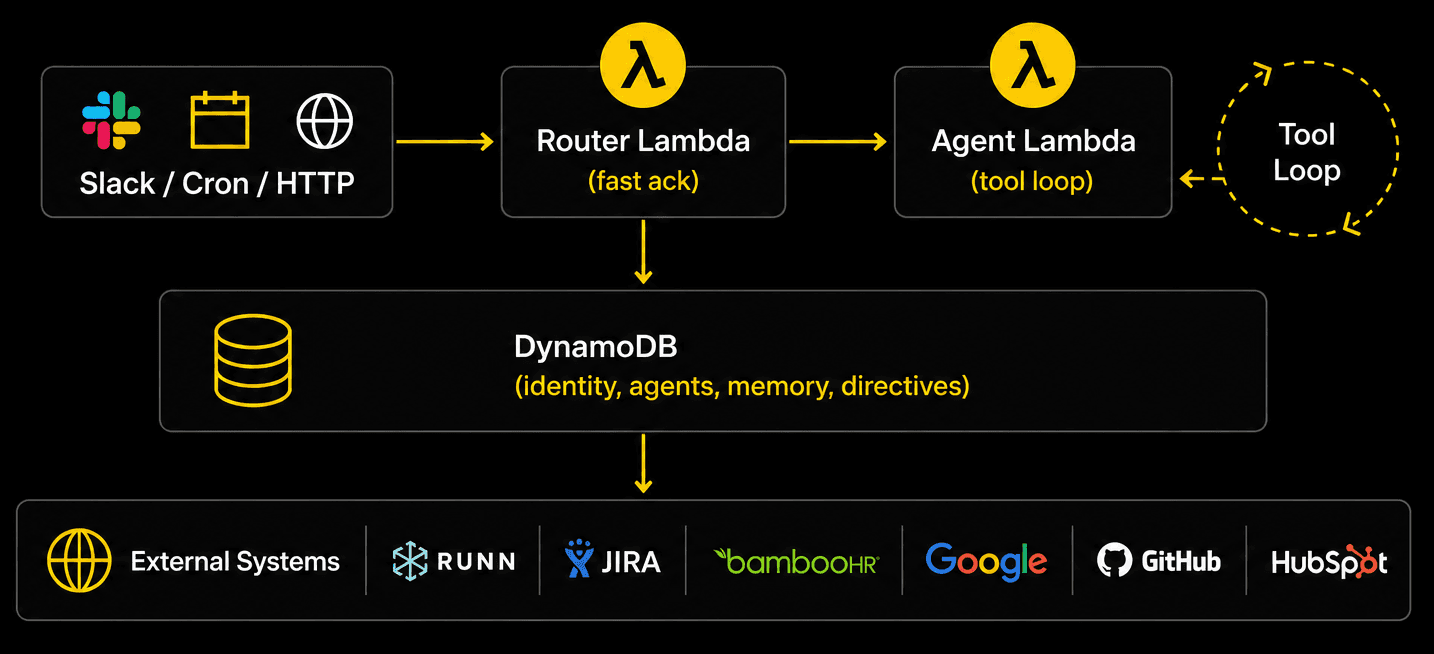
TribalScale built a serverless, AWS-based multi-agent platform powered by a shared Claude tool-use framework and governed enterprise memory system. Agents are invoked through Slack events, scheduled workflows, and asynchronous processing rather than running continuously.
Key platform components include:
Biscuit – People & Culture Agent
Manages employee engagement initiatives, event planning, surveys, approvals, BambooHR integrations, and company-wide communications. Operates through scheduled workflows and reactive Slack interactions.
Gravy – Delivery Manager Agent
Supports project scoping, delivery operations, proposal workflows, case study generation, milestone tracking, and company knowledge retrieval.
Proposal Agent
Automates proposal development through specialized sub-agents that generate project documentation, decks, checklists, and RUNN updates.
Personal Agents
Provides employees with AI-powered support for timesheets, calendar management, JIRA workflows, Google Workspace, HR information, reminders, and productivity tasks.
Case Study Automation
Transforms Slack conversations, project context, and supporting documentation into structured case study drafts that automatically generate pull requests for review.
Architecture Pattern
Design choices informed by ecosystem research:
OpenClaw (Feb 2026) — Tool-loop and memory patterns integrated into People & Culture before agentCore was extracted; weekly digest continues to monitor the open-source personal-agent ecosystem
Paperclip — Run logging, activity audit, and governance primitives (/activity, tool-call decision memories, run summaries)
Hermes (external reference) — Selected onboarding/transparency concepts informed operator commands; no Hermes deployment in this stack
Tools and Technologies Used:

Anthropic Claude Sonnet

Shared Agent Runtime

Tool Registry Framework
AWS Lambda
Amazon DynamoDB
Amazon Event Bridge

Amazon API Gateway
Slack

Google Workplace

Jira

Runn

BambooHR
Github
Apollo

Tavily

Hubspot
Outcome
In approximately four months, TribalScale evolved from a collection of disconnected automations into a production-scale enterprise agent platform supporting delivery operations, people & culture initiatives, proposal generation, and employee productivity. The platform established a repeatable architecture for governed AI adoption, combining shared memory, transparent tooling, privacy controls, and scalable orchestration patterns that now serve as a blueprint for future enterprise agent implementations.