

You did the hard thing.
While competitors were chasing AI demos and standing up pilots on top of fragmented data, your institution made the less glamorous decision. You invested in the foundation. You migrated to the cloud — or you're well into it. You consolidated data assets from across business lines. You stood up a lakehouse or a modern data platform. You hired a Chief Data Officer and gave them a real budget.
The data foundation is real. It's not a slide in a strategy deck. It's running.
And now, two or three years and tens of millions of dollars later, the board is asking a question that gets harder to answer each quarter: Where's the return?
This is The Infrastructure-First Institution — and it represents one of the highest-potential, most strategically misunderstood positions in financial services modernization.
The Pattern
On the TribalScale Financial Services Modernization Index™, the Infrastructure-First Institution shows a profile that's almost the inverse of the AI Experimenter. Data Foundation & Architecture scores at 3.5 or higher — often the strongest of any pillar by a meaningful margin. The cloud migration is mature. Data cataloging exists. There's a unified or near-unified data layer that business lines can access.
But AI & Real-Time Decisioning and Customer Intelligence & Personalization sit notably lower — often in the 2.0–2.8 range. Governance may be moderate, because the data platform buildout drove some governance investment by necessity, but it's not yet mature enough to support AI deployment at scale.
The defining characteristic of this archetype is the gap between investment in infrastructure and activation of that infrastructure for business value. The platform is there. The business-facing capabilities that justify the platform are not.

Why It Happens
The Infrastructure-First Institution made a strategically sound bet. In many ways, it made the right bet — one that will eventually be vindicated. The problem is the "eventually."
The platform buildout consumed the oxygen. Major data infrastructure projects — cloud migrations, data warehouse modernization, lakehouse implementations — are multi-year, multi-million-dollar undertakings that absorb enormous amounts of executive attention, engineering bandwidth, and change management capacity. During the buildout phase, there's little organizational energy left for the "what do we build on top of this" question. The platform becomes the strategy rather than the means to a strategy. Teams that should be thinking about AI use cases and customer intelligence applications are instead debugging data pipelines, negotiating with vendors, and managing the migration backlog.
The CDO/CTO was hired to build, not to activate. Many Infrastructure-First Institutions hired their Chief Data Officer or modernization-focused CTO specifically for the platform buildout — someone with deep experience in cloud architecture, data engineering, and enterprise-scale infrastructure projects. This was the right hire for the phase. But activation — translating the platform into AI models, customer intelligence capabilities, and real-time decisioning — requires a different skill set. It requires someone who thinks in use cases, business outcomes, and cross-functional partnerships, not in data schemas and infrastructure components. The leader who was perfect for Phase 1 may not be the right person to drive Phase 2, and that's a conversation most institutions avoid having.
The business lost patience before the platform was finished. Here's a pattern we see repeatedly: the business lines that were told "wait for the platform" stopped waiting. They stood up their own point solutions — a marketing analytics tool here, a vendor-provided fraud model there, a CRM integration that bypasses the data platform entirely. By the time the central platform was ready, the business had already solved its most urgent problems through workarounds. The platform now has to compete with the tools the business already knows and trusts, even though those tools are inferior in every objective measure. Adoption becomes a change management challenge, not a technology challenge.
There was no activation roadmap alongside the infrastructure roadmap. The most common version of this failure: the data platform project had a detailed implementation plan with milestones, deliverables, and timelines. The activation plan — what gets built on the platform and in what order — was "Phase 2" and was never fully scoped. When the platform reached operational readiness, there was no prioritized queue of use cases, no defined success metrics, and no cross-functional team ready to build. The institution achieved infrastructure readiness and immediately hit a planning vacuum.
The Hidden Risk
The Infrastructure-First Institution's risk is less dramatic than the AI Experimenter's pilot fatigue or the Compliance-Driven Organization's competitive gap. It's subtler and, in some ways, more dangerous: erosion of the business case for modernization itself.
The CFO's patience has a shelf life. Every quarter that the data platform operates without demonstrable business value is a quarter where the investment narrative gets harder to defend. The board approved the infrastructure budget based on a future-value thesis: "This platform will enable AI, personalization, and real-time decisioning that will drive growth and efficiency." If those capabilities don't materialize on a credible timeline, the future-value thesis starts to look like a sunk cost. This doesn't necessarily mean the budget gets cut — the platform is already built. But it means the next investment request gets scrutinized harder. The institution may have built the foundation but lose the appetite to build on it.
The platform itself degrades without activation. A data platform that isn't being used for AI and analytics workloads is a data platform that isn't being stressed, tested, or improved by real demand. Data quality issues that would surface immediately under ML training workloads go undetected. Performance bottlenecks that only appear at scale are never encountered. The platform that looked production-ready in theory turns out to need significant work when actual use cases arrive — work that gets attributed to the platform team's "failure" rather than to the predictable gap between theoretical and operational readiness.
Competitors are catching up on infrastructure while pulling ahead on activation. The Infrastructure-First Institution's advantage — a mature data foundation — is a depreciating asset. Cloud platform vendors are making it faster and cheaper to build data foundations from scratch. Competitors who started later are benefiting from newer architectures, better tooling, and lower migration costs. The Infrastructure-First Institution's two-year head start on infrastructure is worth less each quarter, while the activation gap — the capabilities that aren't yet built — represents an increasing competitive deficit.
The Highest-Leverage Move
The Infrastructure-First Institution doesn't need more infrastructure. It needs activation — and it needs to demonstrate value within one to two quarters to reset the internal narrative.
The highest-leverage move is to identify three high-value AI and customer intelligence use cases, deploy them on the existing platform within 90 days, and use the results to build the business case for a full activation roadmap.
This is a land-and-expand approach. The goal of the first 90 days isn't to solve enterprise-wide AI. It's to produce three tangible proof points that the platform delivers business value.
Selecting the right three use cases is critical. They should meet four criteria: the data already exists in the platform (no new data onboarding required), the business stakeholder is identified and engaged (no finding a sponsor mid-project), the success metric is quantifiable (revenue, cost, or risk reduction), and the technical complexity is moderate (deployable by a small team in 4–8 weeks per use case).
In financial services, the highest-probability candidates are typically customer churn prediction (the data exists in transaction and engagement logs already on the platform), fraud detection enhancement (the platform likely already has the transaction data flowing), and next-best-action for advisors or relationship managers (combining product, transaction, and CRM data that the platform was built to unify).
The point isn't that these are the most transformative use cases possible. It's that they're deployable on the existing platform without additional infrastructure investment, and they produce measurable results that the CFO can point to.
Once three use cases are live and generating value, the activation conversation changes entirely. It moves from "When will this platform pay off?" to "Here's what it's already doing — here's what we should build next." The investment narrative flips from defensive to offensive.
In parallel with the quick wins, build the activation roadmap that should have been scoped alongside the infrastructure buildout. Prioritize use cases by business impact, data readiness, and cross-functional alignment. Sequence them into 90-day deployment cycles. And critically, staff the activation team differently than the infrastructure team — bring in data scientists, ML engineers, and product managers who think in use cases and business outcomes, not in data architecture.
What This Looks Like in Practice
Consider a regional U.S. insurance carrier — $12B in premium, operating across personal, commercial, and specialty lines. Over three years, they invested $25M in a comprehensive data modernization program: migrating from on-premise data warehouses to a cloud-based lakehouse architecture, consolidating data from four legacy policy administration systems, building a unified customer data layer, and implementing data quality monitoring.
The platform was well-built. It handled their regulatory reporting workloads with significantly better performance than the legacy systems. Data access times improved dramatically. The data engineering team had delivered on every milestone.
But when the CEO asked in a quarterly business review what the platform had done for underwriting profitability, customer retention, or claims efficiency, the answer was: not yet.
The underwriting team was still using its legacy pricing models because nobody had built the bridge between the new data platform and their actuarial tools. The claims team knew that AI-driven triage was possible — they'd seen vendor demos — but there was no internal team scoped to build it. The marketing team had purchased a third-party customer analytics tool that sat entirely outside the data platform because they needed answers six months ago and couldn't wait.
Modernization Index profile: Data Foundation at 4.0. Governance at 2.8. AI & Real-Time Decisioning at 1.8. Customer Intelligence at 2.0. A clear Infrastructure-First Institution.
The shift started with a pragmatic decision: pick three use cases, deploy them in 90 days, and prove the platform's value.
Use case one: claims severity prediction. The data was already in the platform — three years of claims history across all lines. A team of two data scientists built a gradient-boosted model that predicted high-severity claims at first notice of loss with meaningful accuracy improvement over the existing rules-based system. Deployed in six weeks. The claims team routed predicted high-severity cases to senior adjusters immediately, reducing late-stage escalations.
Use case two: policyholder churn prediction. Transaction data, payment history, claims history, and customer service interaction logs were all on the platform. A churn model identified policyholders with a high probability of non-renewal 60 days before renewal date. The retention team began targeted outreach. Within one quarter, retention on the flagged segment improved measurably.
Use case three: agent next-best-action. Combining product holding data, life event signals (from public records already ingested into the platform), and coverage gap analysis, the team built a recommendation engine that surfaced the single most relevant cross-sell opportunity for each policyholder when an agent opened their record. The tool required no new data — just a front-end integration with the existing agent portal.
None of these were transformative on their own. But collectively, they produced quantifiable value within one quarter, and every one of them ran entirely on the data platform that had been built over three years. The CFO's question changed from "When will this pay off?" to "What's next?"
The institution subsequently built a 12-month activation roadmap covering 14 additional use cases, hired a Head of AI (reporting to the CDO), and allocated a dedicated activation budget separate from infrastructure maintenance. The data platform they'd invested in for three years finally had a purpose the business could see and measure.
Find Out Where You Stand
The Infrastructure-First Institution has already done the work that most competitors are still planning. The question isn't whether the investment was right — it was. The question is whether you're activating it fast enough to capture the value before the infrastructure advantage depreciates.
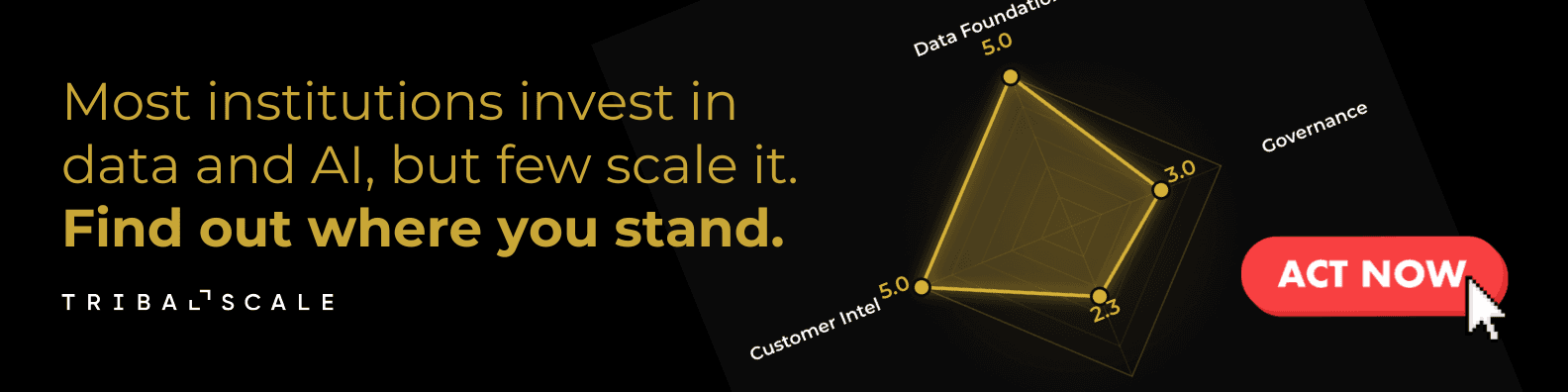
The TribalScale Financial Services Modernization Index™ maps your institution across all four pillars in about five minutes. You'll see whether your data foundation strength is translating into business-facing capabilities — or whether you've built a platform that's still waiting for its first real workload.
This is Part 3 of our Six Profiles of Financial Services Modernization series. Next week: The Legacy Operator — the starting point for most mid-market institutions, and the clearest case for structured transformation.