The Legacy Operator: The Starting Point for Most Financial Institutions, And What to Do About It


Financial Services / PageLet's start with something that needs to be said plainly: there is nothing wrong with being a Legacy Operator.
This isn't a diagnosis. It's not an indictment of leadership, talent, or institutional ambition. The Legacy Operator is, by volume, the most common starting position for mid-market financial institutions in North America — and it's the result of entirely rational decisions made over decades in an industry where regulatory compliance, operational stability, and risk management have always taken priority over technological ambition.
The institutions that score low across all four pillars of the Modernization Index™ aren't behind because they failed. They're behind because the forces that shaped their technology investments — M&A complexity, regulatory burden, thin IT budgets, and the sheer inertia of running mission-critical systems that can't go down — made modernization a lower priority than keeping the lights on.
That calculus has changed. And the Legacy Operator, more than any other archetype, has the clearest case for what to do next.
The Pattern
The Legacy Operator's Modernization Index profile is flat and low. Data Foundation & Architecture, Governance & Regulatory Readiness, AI & Real-Time Decisioning, and Customer Intelligence & Personalization all score below 2.0 — typically in the 1.0–1.8 range.
This doesn't mean nothing works. Operations run. Customers are served. Regulatory obligations are met. But the mechanisms underlying all of it are manual, fragmented, and brittle in ways that become more expensive every year.
Data lives in silos — by business line, by product, by acquisition vintage. There's no unified customer view, no enterprise data catalog, and no single source of truth for core business metrics. Reporting is manual or semi-automated, often involving spreadsheet aggregation from multiple source systems. The concept of a "data platform" is aspirational, not operational.
Governance exists in pockets. Compliance teams manage regulatory obligations through institutional knowledge and manual processes. There's no enterprise-wide data governance framework. Model risk management, to the extent it exists, covers regulatory models (capital, credit) but not analytics or AI.
AI is absent or pre-pilot. The institution may have explored vendor demos or commissioned a consultant's assessment, but there are no models in production. The analytics function, if one exists, runs descriptive reporting rather than predictive or prescriptive workloads.
Customer intelligence is product-centric, not customer-centric. The institution knows what products a customer holds but can't stitch together a behavioral picture across channels and products. Personalization is segment-level at best, manual at worst.
Why It Happens
The core systems are decades old — and they work. The legacy mainframe, the AS/400 policy admin system, the COBOL-based general ledger — these systems are old, expensive to maintain, and functionally limited. They are also astonishingly reliable. They process millions of transactions daily without failure. They've survived every market disruption, every regulatory change, and every leadership transition for 20 or 30 years. Replacing them isn't just technically complex; it requires the institution to accept risk on systems where the current risk is effectively zero. In a risk-averse industry, "it works" is a powerful argument against change.
M&A created a layer cake of incompatible systems. Many mid-market financial institutions grew through acquisition. Each acquisition brought its own core banking system, policy admin platform, CRM, and data stores. Full integration was rarely completed — because the cost was enormous and the operational risk was high. The result, a decade later, is three or four parallel technology stacks serving overlapping customer bases, with integration limited to regulatory reporting requirements. Modernization in this environment isn't a single project. It's an archaeological dig.
IT budgets are consumed by maintenance. Industry data consistently shows that financial institutions in the Legacy Operator profile spend 70–80% of their technology budget on maintaining existing systems. The remaining 20–30% — the discretionary spend that could fund modernization — is small in absolute terms and competed for aggressively by every business line. When IT leadership presents a multi-year modernization roadmap to the CFO, it's competing against branch renovations, product launches, hiring, and a dozen other priorities with more immediate ROI.
There was no burning platform until recently. For most of the 2010s, the Legacy Operator's competitive position was stable. Customers didn't switch banks or insurers frequently. Interest rates were low and margins were thin but manageable. Fintech competition was mostly talk. The cost of inaction was low. What's changed is that the cost of inaction has crossed a threshold. Digital-first competitors are capturing customer segments that used to be captive. AI-driven operational efficiency is creating cost advantages that legacy operations can't match. Regulators are increasingly expecting digital capabilities — real-time fraud detection, automated compliance monitoring, digital customer communication — that legacy infrastructure can't support.
The Hidden Risk
The Legacy Operator's most immediate risk is not existential — mid-market banks and insurers don't disappear overnight. The risk is slower and more corrosive: a gradual loss of competitiveness that compounds over years.
Cost structures become untenable. Manual processes that were affordable when labor was cheaper and transaction volumes were lower become prohibitively expensive as both change. The institution that processes claims manually, underwrites policies with spreadsheet-based models, and generates regulatory reports through human aggregation is spending multiples of what automated competitors spend on the same functions. This cost disadvantage doesn't show up in a single quarter — it accumulates over years, slowly eroding margins.
Customer expectations diverge from institutional capability. The Legacy Operator's customers are using digital banking apps, AI-powered investment platforms, and real-time insurance quoting from competitors and fintechs. Their expectations for speed, personalization, and digital experience are being set by institutions with modern infrastructure. When they interact with the Legacy Operator — slow onboarding, generic communications, limited self-service — the gap is visible and growing.
Regulatory expectations are escalating. Regulators are not just requiring that institutions manage risk. They're increasingly requiring that institutions leverage technology to manage risk better. Real-time transaction monitoring, automated suspicious activity detection, and digital customer due diligence are moving from "best practice" to "regulatory expectation." The Legacy Operator's manual, paper-based compliance processes — even if they meet current requirements — are increasingly out of step with where regulators are heading.
Talent recruitment becomes impossible. Technology talent — not just data scientists, but software engineers, data engineers, cloud architects, and product managers — evaluates employers based on their technology stack. An institution running COBOL mainframes with no cloud footprint and no analytics capability is not competitive in the technology talent market. The Legacy Operator struggles to hire and retain the people needed to execute modernization, which delays modernization further, which makes the institution even less attractive to talent.
The Highest-Leverage Move
The Legacy Operator's challenge is that everything needs to improve. When the gap is across all four pillars, the temptation is either paralysis (where do we even start?) or overambition (let's transform everything at once). Both fail.
The highest-leverage move for the Legacy Operator is to start with data consolidation — a 6–9 month initiative to build a unified data layer that doesn't require replacing core systems.
This is the single decision that creates the most optionality with the least disruption.
The critical insight is that data modernization and core system replacement are not the same project. The Legacy Operator doesn't need to rip out the mainframe to build a modern data foundation. Modern data integration and lakehouse architectures can sit alongside legacy core systems, extracting and consolidating data without touching the systems that produce it. The mainframe keeps running. The AS/400 keeps processing policies. But the data they generate flows into a unified, cloud-based layer where it can be accessed, governed, and eventually used for analytics and AI.
This approach works for the Legacy Operator because it produces value without requiring the institution to take on the risk of core system replacement. It also creates the foundation for every subsequent modernization initiative — AI, personalization, governance automation, and eventually core system replacement itself.
The 6–9 month scope should focus on three outcomes. First, a unified customer data layer that stitches together customer records across the legacy systems created by M&A. This alone — a single customer view — has immediate business value for retention, cross-selling, and regulatory reporting. Second, automated data quality monitoring on the core datasets that will eventually feed analytics and AI workloads. Third, a basic data governance framework — not enterprise-grade governance, but enough structure to manage data access, classification, and lineage on the consolidated layer.
The budget is meaningful but not transformational — typically $2M–$5M for a mid-market institution, depending on the complexity of the legacy environment. This is an order of magnitude less than a core system replacement and can be funded from discretionary IT budget without a board-level capital allocation decision in most cases.
Once the data layer is in place, the institution has a platform to build on. The next move — typically AI pilots on the consolidated data — becomes dramatically easier because the data is accessible, governed, and unified. The Legacy Operator transitions to an Infrastructure-First Institution or a Balanced Modernizer within 12–18 months, without the multi-year, high-risk core system replacement that many institutions assume is the only path.
What This Looks Like in Practice
Consider a community bank in the U.S. Midwest — $6B in assets, three branches acquired through separate acquisitions over 15 years, each running on a different core banking platform. Customer data existed in three separate systems with no common identifier. Regulatory reporting required manual reconciliation across all three platforms, consuming two full-time compliance staff members and producing results with a two-week lag.
The bank had explored full core system consolidation twice. Both times, the project was scoped at $15M+ over three years with significant operational risk. Both times, the board declined. The cost was too high, the risk too great, and the projected ROI too uncertain for an institution with $40M in annual net income.
Modernization Index profile: Data Foundation at 1.5. Governance at 1.8. AI & Real-Time Decisioning at 1.0. Customer Intelligence at 1.3. A Legacy Operator in every dimension.
Instead of a third attempt at core system replacement, the CDO proposed a data-layer-only initiative: extract data from all three core systems into a cloud-based lakehouse, build a unified customer identity layer using probabilistic matching, and stand up automated data quality monitoring on the consolidated dataset.
Budget: $3.2M over nine months. No changes to any core banking system. No branch-level disruption. No operational risk to daily processing.
The results were tangible before the project was complete. By month five, the bank had its first-ever unified customer view — the ability to see a customer's full relationship across all three acquired entities. The compliance team's manual reconciliation process was automated, freeing 70% of the two staff members' time and reducing the reporting lag from two weeks to two days.
By month nine, with the data layer operational, the bank deployed its first analytics use case: a deposit attrition model that identified at-risk commercial deposit relationships 45 days before they moved. The model was simple — a logistic regression trained on transaction patterns — but it was the first time the bank had any predictive capability, and it ran on data that six months earlier had been trapped in three incompatible core systems.
The core banking systems were still running on their legacy platforms. But the data they produced was now consolidated, governed, and actionable. The bank's next investment request — for AI-driven credit risk scoring — sailed through board approval because the data foundation was already in place.
Find Out Where You Stand
If your institution runs on systems that are decades old, has grown through acquisition without full integration, and spends most of its technology budget keeping the lights on — you're probably a Legacy Operator. That's not a criticism. It's a starting point.
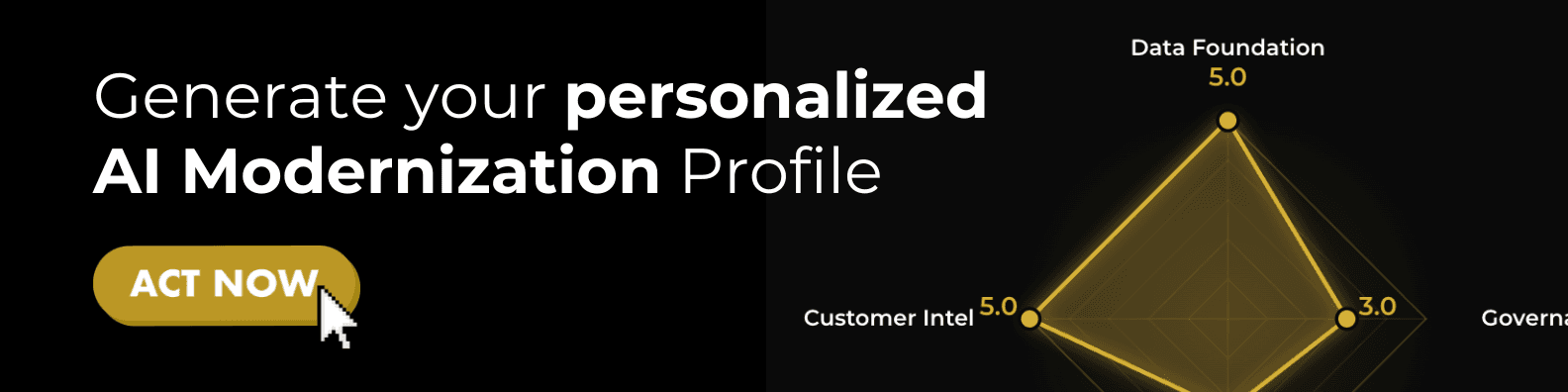
The TribalScale Financial Services Modernization Index™ maps your institution across all four pillars in about five minutes. You'll see where you are, where the gaps are, and what the single most impactful first move looks like for an institution with your profile.
This is Part 4 of our Six Profiles of Financial Services Modernization series. Next week: The Balanced Modernizer — the institution that's solid everywhere and exceptional nowhere.